
When the Lights Go Out
A map of cinematic loneliness.
If loneliness is the distance that separates us from others, nowhere are you lonelier than in space. In Solaris (1972), Tarkovsky paints the first constellation of cosmic depression. From Soderbergh’s less languorous remake, to Duncan Jones’s Moon and Claire Denis’s High Life, the astronaut retains the glamorous aura of a space-age hermit. When the roles are reversed, the alienation stays put: in The Man Who Fell to Earth (1976), Newton, the extraterrestrial played by a spaced out Bowie, goes looking for humanity and discovers depression. As for Tarkovsky, the spleen is heavier still in the Zone. In Stalker (1979), the hero once again does have two companions, but to no avail.
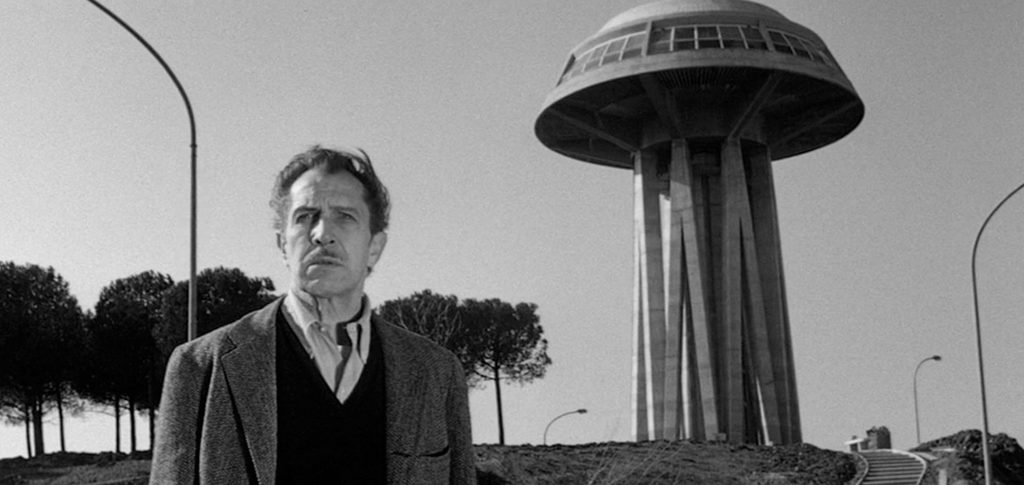
Then there is the extreme case: loneliness proper. Total. Implacable. Its most potent symbol is the empty supermarket, the nightmare landscape par excellence. Robert Morgan, the hero of The Last Man on Earth (1964), adapted from a novel by American author Richard Matheson, helps himself to its bounty with the flair of only practice can instill. Played by Vincent Price, Morgan lives a life of pure inertia, steeping the screen in a mixture of sarcasm, weariness and disgust. Jazz and alcohol are prescribed as remedies for his loneliness, along with the company of a little dog that happens to wander across Morgan’s lawn and that he will later rescue—just before the last man on Earth discovers he isn’t quite the last after all.
The remake, The Omega Man (1971), is made from the same dough, but tastes different, looks different, smells different—in short, it’s something else entirely. Morgan still listens to jazz, but not because it’s popular (it no longer is), but because he must ooze refinement from every pore: he wears velvet, plays chess, and fills his home with paintings and busts. For all that, he isn’t too refined to open fire with an automatic weapon eighty seconds into the film, with the grace of a day labourer wielding a spade—an operation he will repeat with some frequency. Robert goes bare-chested at the drop of a hat, and when he discovers there is also a last woman on Earth, it is by no means clear whether he wants to talk to her or rape her. In Charlton Heston’s hands, Matheson’s hero acquires messianic overtones, but this is a Jesus upon whom no grace descends except the grace of self-delight.
In I Am Legend (2007), the empty supermarket gives way to an empty New York, an even more unsettling sight. The gentle-eyed dog returns, while jazz is replaced by golf. I Am Legend is The Omega Man purged of camp, with action scenes that aren’t terribly convincing, and a hero endowed with a new defining trait. Crushed by overwhelming sadness, Will Smith’s sharpshooting doctor is endearing, up to a point. Still, it’s progress: at least he’s no longer cringe.
Little boys blue, little girls wear pink, and screenwriting is a man’s job. Cinematic loneliness is, therefore, overwhelmingly male. Gallant up to a point, these men who suffer and then suffer some more will occasionally grant their female counterparts the luxury of experiencing a feeling or two themselves. Among these exceptions are the characters played by Gena Rowlands in John Cassavetes’s films. In A Woman Under the Influence (1974), Mabel is all the lonelier for being permanently surrounded by other people (none of whom misses an opportunity to point out that every modulation of her temperament is somehow inappropriate). In Opening Night (1977), Myrtle enlists alcohol in her struggle with post-traumatic stress and with a role she is trying to tame. Finally, in Gloria (1980)—the most anaemic of Cassavetes’s major films, ancestor to Besson’s Léon and a hymn to the hustle—the heroine stands alone against a band of mobsters, her sole support the compliments doled out with extreme parsimony by a six-year-old boy.
Monica Vitti as seen through the eyes of Antonioni, poet of silences and anxieties. Delphine in Le Rayon Vert (1986), whose loneliness is no less oppressive simply because its immediate cause is the summer holiday, a French institution every bit as tangible as the tax office or the gendarmerie. Rosemary in Polanski’s 1968 horror film, who, like Mabel, is alone in the middle of a pack. Ines in Toni Erdmann (2016), alone in a Bucharest that is welcoming yet no less foreign, prey to harassment that ultimately spells as salvation. Ozana Oancea’s Felicia, alone in the same Bucharest, ceaselessly subjected to low-intensity assaults by forces she is powerless to control. Benni in System Crasher (2019), alone in a system lavishly generous to those who conform to it—and to them alone. Clara in Aquarius (2016), alone against the termites of real-estate speculation, in a Brazil growing ever more inhospitable and incomprehensible.
Loneliness has no gender and no homeland. It is everywhere, and there is no shelter from it. Neither behind the screen, nor in front of it.
Originally published in Dilema Veche as part of a dossier on loneliness