Narrative in the Age of Netflix
Cinematic algorithms.
The protagonist lies sprawled on the floor, eyes glazed, lips blue, her forehead, right cheekbone and neck pierced by as many bullets: rigor mortis has already set in. For now, her interior monologue tells us nothing; it will only make sense later.
The protagonist is on a bridge, dragging himself forward with the last of his strength, bleeding profusely. A bullet punches through his body: it is only a matter of time before he breathes his last. His flashback to a pair of legs pirouetting on a beach is not especially enlightening either; the legs will acquire a body, complete with the requisite biographical background, only later.
The protagonist is about to set off on an expedition that we already know—from the voice-over which opens the film—cannot possibly succeed if children are among the party: we are lead to assume she is about to die. The speech she delivers to a boy and girl who cannot be more than five years old is, for the moment, impossible to decipher.
The films are The Old Guard, Netflix’s latest blockbuster (released on July 10 of 2020, with every prospect of climbing to at least No. 4 in the company’s all-time rankings), Extraction (released on April 24 of 2020, 99 million views, most-watched film of all time on Netflix) and Bird Box (released on December 21 of 2018, 89 million views, second most-watched film of all time on Netflix).
Each time, we meet the main character almost immediately: thirteen seconds into The Old Guard (first we see her fallen comrades); thirty-five seconds into Extraction (preceded by a series of aerial shots of Dhaka, where almost all of Acts II and III will take place); and thirty-seven seconds into Bird Box (again preceded by aerial shots, this time of the river where much of Act III will unfold). What differs significantly is the time separating these introductory flash-forwards from the revelation of their full meaning. Before we discover why Andromache (Charlize Theron) is lying on the floor, what Tyler Rake (Chris Hemsworth) is doing on that bridge, or why Malorie (Sandra Bullock) orders the two children to keep their eyes covered, 13, 93 and 100 minutes elapse, respectively.
The Old Guard is neither the first nor the last superhero-comic adaptation to suffer from a permanent sense of haste. There is plenty of walking, even more running, and cuts come thicker and faster than hurdles in a steeplechase. Sometimes these choices are justified—for instance, in the establishing shots of a Moroccan bazaar at minute six, cut to trap music. When they mean chopping the fight sequences into fragments until they hover on the brink of unwatchability, there is no reward to it, quite the contrary. To make matters worse, the camera is positioned so close to the actors, that it is almost always difficult to work out either where the many blows exchanged by the characters are coming from, or where they are going. All we understand is that there are fists going into faces and bullets going through bodies, across a long succession of badly lit interiors.
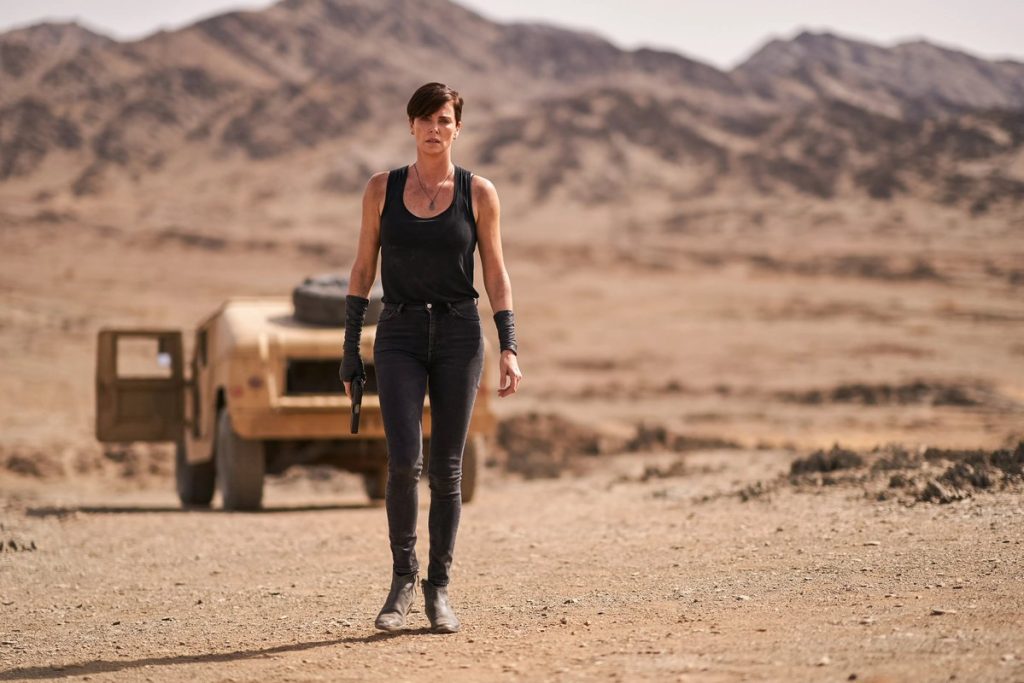
Against this backdrop, the heroine has the honour of dragging a practically unused axe from scene to scene with the same blank expression, rescuing assorted groups of characters in distress, stating the obvious time and again. For instance, that the hostages her team of mercenaries was supposed to rescue don’t actually exist, or that the man who betrayed them—a former CIA agent—is to be found and killed. At minute seventeen, Andy assigns Booker the task of tracking him down, then reminds him what he is supposed to be doing three times—at minutes 24, 35 and 63. This is less a sign that she doubts Booker’s memory, than yet another symptom of screenwriter Greg Rucka’s distrust—or rather that of Netflix’s army of executives, great and small, behind her—of us, the viewers.
To return to the opening flash-forward: any of these three Netflix flagships could, of course, have done without it. But that would have meant allowing our interest in the film—watched at home, on one screen among many—to grow with each new scene, and our attention to be earned rather than stolen. The opening device performs the function of the preview at the end of any episode of a television series, which is precisely the medium Netflix rules upon with an iron fist. We now know what will happen “in the next episode”. Before the first minute is out, the bait has already been cast.
Nor are these the only examples among Netflix’s ten most-watched titles of narrative leaps being deployed as preemptive measure. In The Irishman (No. 6), the protagonist is introduced at second 80; then, at second 129, a hand squeezes a trigger and the bullet travels a very short distance to a head. For now, we suspect whose hand it is, but do not know who the head belongs to; that information arrives only at minute 167 of the film’s 210. Spenser Confidential (No. 3), meanwhile, begins with a flashback, with its hero appearing at second 45, while 6 Underground (No. 4, produced by Skydance Media, which also produced The Old Guard) opens with the line: “What if I told you I know what happens when you die?” The protagonist appears at second 73 and dies at second 149—though his is a fake death (we know this from the voice-over, also his, and receive confirmation when the event is replayed at minute 43, this time fleshed out with a series of biographical details).
Once we have taken the bait, we discover that plot twist and betrayal are virtually synonymous. Carefully spaced across the respective 125, 117 and 124 minutes of the three films under consideration, betrayal comes from an outsider—in two out of three cases, the person who commissioned the operation—as well as from a teammate. In The Old Guard, former CIA agent Copley is the first to betray (minute 14), followed by Booker (minute 82). In Extraction, Saju is the first to play traitor (minute 34), followed by Gaspar, a former comrade of the hero (minute 74). In Bird Box, the group of survivors takes its first blow from housemates Felix and Lucy, who steal the only car in the garage (minute 55), followed by newcomer Gary, who proves to be the force that shatters their hard-won equilibrium (minute 78).
All three protagonists suffer from emotional trauma: the loss of a loved one in The Old Guard, the death of a child in Extraction, an abusive father in Bird Box. But these traumas matter to varying degrees. In Extraction, for example, they are largely decorative, like any minute that contains neither a chase, nor a fight. While The Old Guard spreads across Morocco, Sudan, Afghanistan, Goussainville, London and Paris, Extraction needs only three locations, unevenly distributed in both time and geography: Australia (where the protagonist spends no more than five minutes), then Mumbai and Dhaka. A child is kidnapped in Mumbai; the hero tries to retrieve him in Dhaka. Simple and effective, thanks above all to action sequences that are impeccably choreographed and shot, with takes improbably long not merely for a Netflix action thriller, but for any film, regardless of genre, producer or medium. Outdoors in particular, the camera slips, crawls, circles or darts wherever needs call for it, moving in and out of cars and rooms, gliding fluidly from one character to another and borrowing their point of view.
When they are not shot dead—the method of choice—the characters disappear from the frame and get on with whatever they have to do, only to reappear several minutes later and resume their mission to kill Tyler undeterred. We are therefore presumed capable of remembering that a character called Saju exists even while he is no longer on screen (and, what is more, when he returns, his reappearance is treated as the most natural thing in the world). In this respect, Extraction has more in common with Mad Max: Fury Road than with The Old Guard. From minute nineteen, when Tyler kills his first enemy, Sam Hargrave’s debut feature delivers at least eighty minutes of virtually unbroken action.
In Bird Box, by contrast, the action sequences recede into the background. The survival story comes second to a character arc. The real stake is therefore less the protagonist’s survival, than the transformations the journey towards the final sanctuary entail—specifically, her acceptance of motherhood. Until that point, because they would demand from us a relatively high degree of participation, but also because they are disposable, many conclusions come wrapped in a box. We might, for instance, work out for ourselves that the other characters are committing mass suicide because they have seen something, though no one knows what. But it is easier to have one of the film’s characters serve this reasoning up to us on a platter, just seven minutes after the first alarm bell: a patient at the hospital where Malorie has gone for a gynaecological check-up repeatedly smashing her head against a glass wall.
Finally, thanks to colour grading, the North American woods in which Malorie makes peace with herself don’t look all that different from Morocco, Sudan, Afghanistan, France or England where Andy carries her axe in The Old Guard, while also recalling the Australia, India or Bangladesh we know from Extraction.
The Netflix universe: the same colours North to South and East to West; a simple world in which betrayal is unfailingly followed by revenge, and everything is explained—by voice-over in three cases out of six. A world untouched by doubt, unshadowed by mystery.
Originally published on the Film Reporter platform in august 2020